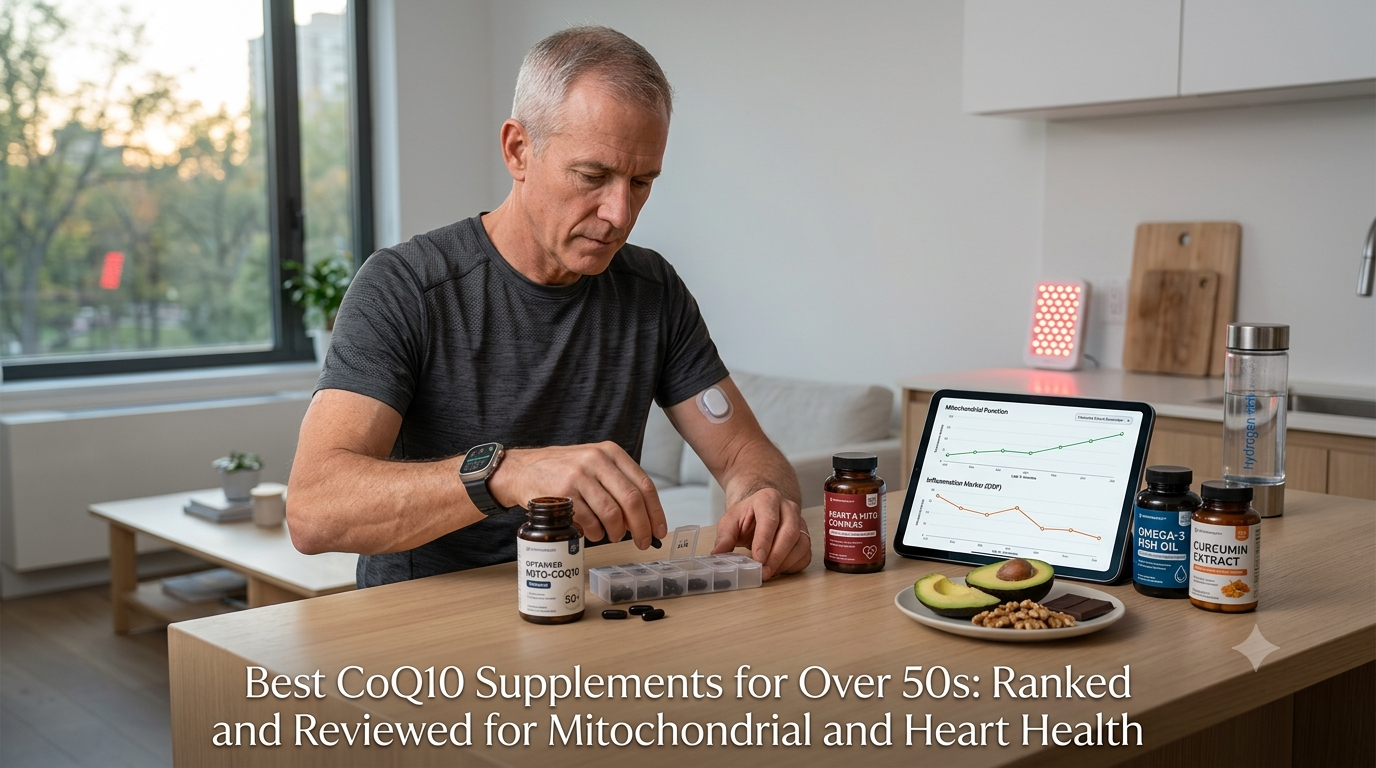
CoQ10 is non-negotiable after 50 — but form, dose, and quality vary enormously between products. Discover the best CoQ10 supplements for mitochondrial health, inflammation reduction, and heart protection, ranked and reviewed.
Introduction
Here’s a number that should genuinely alarm anyone over 50 who isn’t currently taking CoQ10. Research has shown that CoQ10 production in the human body peaks in the mid-twenties and declines by approximately 50% by the time you reach 70. That’s a catastrophic reduction in one of the most critical molecules in your mitochondrial energy production system — and the consequences show up everywhere: declining energy, worsening exercise recovery, rising inflammatory markers, and a cardiovascular system that’s operating with progressively less of the cellular fuel it needs to function optimally. If you’re on a statin — and approximately 35% of adults over 50 in the United States are — that depletion is even more severe, because statins inhibit the same biological pathway your body uses to synthesize CoQ10.
CoQ10 is the supplement I discuss more than almost any other when someone over 50 asks me where to start with mitochondrial and anti-inflammatory supplementation. The evidence base is deep, the mechanism is well-understood, and the clinical research on its effects on inflammatory markers, cardiovascular function, and mitochondrial health is genuinely compelling. But — and this is the critical part that most people get catastrophically wrong — not all CoQ10 supplements are the same. The form, the dose, the delivery technology, and the quality of the raw ingredient vary so dramatically between products that two products both labelled “CoQ10 200mg” can have almost nothing in common in terms of actual biological effect.
I’ve been through the process of sorting the meaningful from the mediocre in CoQ10 supplementation, and this review distills what I’ve learned from the research and my own protocol into a practical buying guide specifically designed for adults over 50. We’re going to cover the biochemistry you need to make an informed decision, the quality markers that distinguish genuinely effective products from expensive placebos, and clear category-based recommendations that make choosing the right CoQ10 for your specific situation as straightforward as possible.
Why CoQ10 Becomes Critical After 50 — The Science Recap
CoQ10 — coenzyme Q10, also called ubiquinone in its oxidized form or ubiquinol in its reduced form — is a fat-soluble molecule that serves as one of the most critical components of the mitochondrial electron transport chain. In simple terms, it shuttles electrons between the protein complexes that produce ATP — the cellular energy currency your heart, brain, muscles, and every other energy-demanding tissue runs on. Without adequate CoQ10, the electron transport chain runs inefficiently, ATP production drops, and the byproduct of inefficient electron transport — reactive oxygen species — increases dramatically.
This ROS increase is the direct link between CoQ10 depletion and chronic inflammation. As we established in our mitochondria article, dysfunctional mitochondria leak ROS that activate the NLRP3 inflammasome and trigger the release of pro-inflammatory cytokines including IL-1β, IL-6, and TNF-α. They also release mitochondrial DNA fragments that are recognized by innate immune sensors as danger signals, producing a chronic sterile inflammatory response that drives inflammaging. CoQ10 — in its reduced ubiquinol form — is one of the most potent antioxidants specifically within the mitochondrial membrane, where it directly quenches ROS before they can activate these inflammatory cascades. Depleting CoQ10 removes this critical mitochondrial antioxidant protection precisely when the mitochondria are under the most age-related stress.
The 50% decline between ages 40 and 70 is not a gentle gradient — research suggests the most significant decline occurs between 40 and 60, which is exactly when the metabolic consequences of mitochondrial dysfunction begin expressing themselves as chronic fatigue, exercise intolerance, rising inflammatory markers, and declining cardiovascular function. The heart muscle — which has the highest CoQ10 concentration of any tissue in the body due to its extraordinary energy demands — is particularly vulnerable to this decline. Research has consistently documented lower myocardial CoQ10 levels in adults with heart failure and cardiovascular disease compared to age-matched healthy controls, and clinical trials supplementing CoQ10 in heart failure patients have shown meaningful improvements in cardiac function.
The statin connection deserves specific emphasis because it’s simultaneously one of the most significant clinical CoQ10 depletion mechanisms and one of the most underappreciated by both patients and prescribing physicians. Statins work by inhibiting HMG-CoA reductase — an enzyme in the mevalonate pathway that produces both cholesterol and CoQ10. By blocking this pathway, statins predictably deplete CoQ10, often dramatically. Research has documented CoQ10 declines of 40-50% in statin users compared to non-users. The muscle pain and weakness (myopathy) that affects a significant minority of statin users is now understood to be at least partly driven by statin-induced CoQ10 depletion impairing mitochondrial energy production in muscle tissue. If you’re on a statin and experiencing muscle pain, fatigue, or exercise intolerance, CoQ10 supplementation should be an immediate priority — and a conversation with your prescribing physician.
Diet is unfortunately not a meaningful solution to age-related CoQ10 depletion. While CoQ10 is found in organ meats, fatty fish, and some nuts, the amounts are so small relative to the therapeutic supplemental doses that dietary intake contributes only marginally to CoQ10 status. A serving of beef heart — the richest dietary CoQ10 source — contains approximately 11mg of CoQ10, compared to the 200-400mg daily doses used in clinical trials for mitochondrial and anti-inflammatory benefit. Supplementation is the only practical route to therapeutic CoQ10 levels after 50.
Ubiquinol vs. Ubiquinone — Why This Is the Most Important CoQ10 Decision
The single most important decision you’ll make when buying a CoQ10 supplement is which form to choose — and the majority of people who currently take CoQ10 are taking the wrong one for their age group. This isn’t a subtle distinction. It can mean the difference between a supplement that meaningfully improves your mitochondrial function and inflammatory markers, and one that delivers minimal measurable benefit despite significant cost.
Ubiquinone is the oxidized form of CoQ10 — the form found in most CoQ10 supplements and the form that has been studied the longest. It’s also the cheaper form to produce, which is why it dominates the market. In younger adults, ubiquinone is well utilized because the body readily converts it to ubiquinol — the active, reduced form that actually functions in the mitochondrial electron transport chain and performs the antioxidant role within mitochondrial membranes. The conversion from ubiquinone to ubiquinol is an enzymatic process that requires adequate cellular reducing capacity.
Here’s the problem after 40. This ubiquinone-to-ubiquinol conversion becomes significantly less efficient as we age — driven by declining cellular antioxidant capacity, increasing oxidative stress, and reduced enzyme activity. Research published in the journal BioFactors has shown that ubiquinol achieves significantly higher plasma CoQ10 concentrations than equivalent doses of ubiquinone in older adults — with some studies documenting two to three times greater bioavailability from ubiquinol in adults over 50. The practical implication is clear: if you’re over 50, ubiquinol is the form that actually reaches your mitochondria in meaningful concentrations. Ubiquinone is the cheaper option that may be largely wasted if your conversion capacity is impaired.
When might ubiquinone still be appropriate? For people under 40 with good general health, ubiquinone conversion is typically adequate and the cost savings may be meaningful. For adults over 50 on statins who need higher absolute doses, ubiquinol at the appropriate therapeutic dose is still the preferred form, but some practitioners use ubiquinone at higher doses as a cost-management strategy — though the evidence clearly favors ubiquinol for this age group. And for some specific clinical applications where the oxidized form has been specifically studied, ubiquinone may be the appropriate choice — but these exceptions are relatively rare in the over-50 general inflammation and mitochondrial health context.
Identifying which form you’re buying from product labels sounds straightforward but can be surprisingly confusing given the marketing language used by some supplement companies. Ubiquinol will typically be labeled explicitly as “ubiquinol” or “CoQ10 as ubiquinol.” Products using the Kaneka QH branded ingredient — the most research-backed ubiquinol form — will specify this on the label. Products labeled simply as “CoQ10,” “coenzyme Q10,” or “ubiquinone CoQ10” are the oxidized form. Some products attempt to confuse by labeling ubiquinone as “enhanced CoQ10” or similar — if the label doesn’t explicitly state ubiquinol, assume you’re getting ubiquinone and factor this into your purchasing decision.
What to Look For When Buying CoQ10 — The Quality Markers That Matter
Beyond the ubiquinol vs. ubiquinone decision, several additional quality markers separate genuinely effective CoQ10 products from the crowded field of mediocre and misleading options.
The Kaneka QH branded ingredient is the gold standard ubiquinol raw material and the one with the most published research supporting it. Kaneka Corporation — a Japanese biotech company — developed the first commercially produced ubiquinol and has backed its ingredient with extensive clinical research. Many of the human trials on ubiquinol that show significant mitochondrial and anti-inflammatory benefits used Kaneka QH specifically. When a product label specifies Kaneka QH, you have the highest available confidence that the ubiquinol in the product is genuine, stable, and produced to pharmaceutical-grade standards. Not all effective products specify their CoQ10 source — some use high-quality ubiquinol from other producers — but Kaneka QH on the label is the clearest quality signal available.
Third-party testing certification provides independent verification that a product actually contains what the label claims, at the doses stated, without contamination. The most meaningful certifications for CoQ10 specifically are NSF International’s NSF Certified for Sport or Contents Certified programs, USP Verified, and Informed Sport. These organizations independently test products and verify ingredient identity, potency, and purity — critical in a supplement market where studies have found that many CoQ10 products contain significantly less CoQ10 than stated on the label. If a product has no third-party certification, you’re relying entirely on the manufacturer’s self-reported quality claims.
Optimal dose ranges for the anti-inflammatory and mitochondrial health goals relevant to people over 50 are well-established in the clinical research. For general mitochondrial support and anti-inflammatory benefit, 200mg of ubiquinol daily is a reasonable and well-studied starting dose. For statin users, people with significant cardiovascular risk, or those with markedly elevated inflammatory markers, doses of 300-400mg daily are supported by research and commonly used in clinical practice. Very high doses (above 600mg daily) are occasionally used in specific clinical contexts but provide diminishing returns for general inflammaging management and significantly increase cost without proportional benefit.
Delivery format matters more for CoQ10 than for many other supplements because of its fat-solubility. Softgel capsules containing CoQ10 dissolved in a carrier oil — typically olive oil, MCT oil, or sunflower oil — provide the best absorption by pre-dissolving the CoQ10 in a lipid medium that facilitates uptake through the intestinal wall. Powder-filled hard capsules have lower absorption unless the CoQ10 has been specifically formulated for improved dispersion. The most innovative delivery systems — including micro-encapsulated and crystal-free ubiquinol formulations — can achieve further improved bioavailability compared to standard oil-based softgels, and these are worth considering particularly for people whose CoQ10 levels remain low despite standard softgel supplementation.
Taking CoQ10 with food is not optional — it’s a requirement for adequate absorption. CoQ10 is fat-soluble, meaning its absorption from the gut depends on the presence of dietary fat to form the mixed micelles that carry fat-soluble compounds across the intestinal wall. Research has shown that CoQ10 absorption is two to three times higher when taken with a fat-containing meal compared to a fasted state. For most people, taking CoQ10 with breakfast — particularly if breakfast includes eggs, avocado, nuts, olive oil, or other fat sources — maximizes absorption and establishes a consistent daily habit. If your largest or fattiest meal is at lunch or dinner, that timing is equally appropriate.
Red flags that should prompt you to look elsewhere include: products priced significantly below market average for their stated dose (CoQ10 is expensive to produce and very cheap products often reflect very cheap ingredients), proprietary blend labeling that obscures the actual CoQ10 dose, marketing that makes dramatic claims about specific clinical outcomes without referencing actual clinical research, and products that combine CoQ10 with numerous other ingredients in a “comprehensive formula” that underdoses every component including the CoQ10 itself.
Top CoQ10 Supplement Categories for Over 50s
Rather than ranking specific branded products by name — which can change in availability and formulation — I’m going to identify the key categories that matter for over-50s and what each category should deliver, allowing you to evaluate any product you’re considering against objective criteria.
Category 1: Best Overall Ubiquinol CoQ10
The gold standard choice for most adults over 50 is a straightforward ubiquinol softgel using Kaneka QH at 200-300mg per serving, with a minimal clean ingredient list (ubiquinol, carrier oil such as olive or MCT, softgel capsule). What to look for: Kaneka QH specified on the label, NSF or USP certification, softgel delivery in a carrier oil, no unnecessary additives or fillers, and a price point consistent with genuine ubiquinol quality (expect to pay more than standard ubiquinone products — this is appropriate and reflects genuine ingredient quality).
Category 2: Best CoQ10 for Statin Users
Statin users need higher doses and maximum absorption efficiency. The optimal product in this category delivers 300-400mg of Kaneka QH ubiquinol per serving in a high-quality carrier oil softgel, ideally with third-party testing certification. Some products in this category add vitamin E as a synergistic antioxidant that recycles ubiquinol within mitochondrial membranes — a scientifically grounded addition that can meaningfully enhance effectiveness. Statin users should discuss their CoQ10 supplementation with their prescribing physician, as CoQ10 can modestly affect the metabolism of certain medications.
Category 3: Best Budget-Conscious CoQ10 Option
For people who need to balance quality with cost constraints, the best approach is a ubiquinol product from a reputable manufacturer that may use a high-quality non-branded ubiquinol ingredient rather than the premium Kaneka QH. Third-party testing remains important even for budget options — this is where the investment in NSF or USP certification most matters, as it provides potency verification without the Kaneka QH premium. A quality budget ubiquinol product should deliver 200mg per serving in an oil-based softgel at a significantly lower price point than premium products while maintaining verifiable ingredient purity and potency.
Category 4: Best CoQ10 with PQQ Combination
The CoQ10 plus PQQ combination specifically targets mitochondrial biogenesis — the creation of new mitochondria — alongside mitochondrial efficiency improvement. PQQ (pyrroloquinoline quinone) is the only compound with evidence for actually stimulating the growth of new mitochondria, and it synergizes beautifully with CoQ10’s role in optimizing the function of existing mitochondria. A quality combination product should deliver Kaneka QH ubiquinol at 200mg alongside PQQ at 10-20mg in an oil-based softgel — both fat-soluble compounds that absorb well together. This combination is particularly relevant for people whose primary complaint is persistent fatigue and energy deficit alongside inflammatory symptoms, where both mitochondrial quantity and quality improvement is the target.
Category 5: Best Water-Soluble CoQ10 — Enhanced Absorption Technology
Several manufacturers have developed CoQ10 formulations that dramatically improve bioavailability beyond oil-based softgels through water-soluble or micro-encapsulated delivery systems. Products using cyclodextrin complexing, colloidal dispersion technology, or nano-emulsification can achieve significantly higher plasma CoQ10 concentrations at equivalent doses compared to standard oil-based softgels. These products are particularly relevant for people who have been taking standard CoQ10 for three or more months without noticing meaningful improvement in energy, HRV, or other tracked outcomes — suggesting that absorption may be a limiting factor. Water-soluble CoQ10 products typically command a premium price reflecting their more sophisticated manufacturing process.
How CoQ10 Fits Into the Complete Anti-Inflammatory Protocol
CoQ10 doesn’t operate in isolation — it’s most powerful as part of the comprehensive mitochondrial and anti-inflammatory protocol we’ve built across this series. Understanding how it integrates with other interventions helps you time and stack it intelligently for maximum effect.
The CoQ10 and Zone 2 cardio combination is the mitochondrial performance stack that I consistently see producing the most noticeable improvements in energy and exercise capacity in adults over 50. Zone 2 training stimulates mitochondrial biogenesis through PGC-1α activation — creating new mitochondria. CoQ10 ensures those mitochondria have adequate electron transport chain support to function at optimal efficiency — maximizing the energy output of each mitochondrion that Zone 2 creates. Research has documented that supplemental CoQ10 combined with aerobic exercise training produces greater improvements in exercise capacity and inflammatory markers than either intervention alone — making this combination particularly compelling for people implementing the Zone 2 protocol from our dedicated exercise article.
The NMN or NR and CoQ10 synergy operates through complementary mitochondrial pathways. NAD+ precursors restore the NAD+ that fuels sirtuin activity and provides electrons to the electron transport chain. CoQ10 shuttles those electrons efficiently through the electron transport chain complexes to produce ATP. Together, they address both the substrate (NAD+) and the electron carrier (CoQ10) that mitochondrial energy production requires — a genuinely synergistic combination that produces greater mitochondrial function improvement than either supplement alone. Timing both in the morning with a fat-containing breakfast maximizes the practical convenience of this stack.
Omega-3 fatty acids and CoQ10 work together at the mitochondrial membrane level in a way that’s mechanistically elegant. Omega-3s are incorporated into mitochondrial membranes and improve membrane fluidity — which is critical for the mobility of CoQ10 within the membrane during electron transport. CoQ10 performs its electron shuttling role within the mitochondrial inner membrane, and a membrane that’s more fluid from adequate omega-3 incorporation allows CoQ10 to move more freely between the electron transport chain complexes, improving its functional efficiency. These two fat-soluble supplements are naturally complementary and absorb better when taken together with a fat-containing meal.
Magnesium and CoQ10 together form the foundation of mitochondrial energy production support. As discussed in our supplement article, magnesium is a cofactor in over 300 enzymatic reactions, many directly in the ATP synthesis pathway. Without adequate magnesium, ATP cannot be effectively produced or utilized even when CoQ10 is present and the electron transport chain is running efficiently — because ATP exists and functions in the cell primarily as a magnesium-ATP complex. Magnesium deficiency is nearly universal in adults over 50, and addressing it alongside CoQ10 ensures that the energy production improvements from CoQ10 supplementation can actually be captured and utilized at the cellular level.
How does CoQ10 supplementation show up in the objective tracking metrics we’ve established throughout this series? HRV typically improves measurably within four to eight weeks of therapeutic CoQ10 supplementation in people with depleted baseline CoQ10 — reflecting improved autonomic nervous system function from better mitochondrial energy support in cardiac and nervous tissue. hsCRP reductions from CoQ10 supplementation typically emerge over twelve to sixteen weeks and are most significant in people with elevated baseline CRP — consistent with CoQ10’s mechanism of reducing the ROS-mediated inflammatory signaling from dysfunctional mitochondria. Energy and exercise recovery improvements are often the first subjective changes people notice — typically within two to four weeks — and provide meaningful early feedback that the supplementation is producing biological effect.
A realistic timeline for noticing CoQ10 benefits after 50 sets appropriate expectations and prevents premature discontinuation. Subjective energy improvements: two to four weeks at therapeutic dose. Exercise recovery improvement: three to six weeks. HRV improvement: four to eight weeks. Measurable reductions in CRP or other inflammatory markers: twelve to twenty weeks. These timelines reflect the gradual nature of mitochondrial adaptation and the slow turnover of the cellular and immune processes that determine inflammatory marker levels. Consistency over months — not days — is the key to experiencing CoQ10’s full anti-inflammatory and mitochondrial benefit.
Conclusion
CoQ10 in the ubiquinol form is the supplement I’d prioritize above almost all others for adults over 50 concerned about mitochondrial function, chronic inflammation, and cardiovascular health. The evidence base is extensive, the mechanism is well-understood, the clinical research is compelling, and the consequences of chronic CoQ10 depletion — worsening mitochondrial dysfunction, rising inflammatory markers, declining cardiac function — are too significant to ignore after 50. The key messages from this review are simple: choose ubiquinol over ubiquinone, look for Kaneka QH on the label where possible, get third-party tested products, take it at 200-400mg with your fattiest meal, and give it at least three months before assessing its impact on your tracked outcomes.
Form and quality matter far more than price in the CoQ10 market. A cheap ubiquinone product at 100mg without quality verification is not a bargain — it’s a false economy that delivers minimal mitochondrial benefit while giving you the illusion of doing something about your CoQ10 status. A quality ubiquinol product at the appropriate therapeutic dose, taken consistently with a fat-containing meal as part of the comprehensive anti-inflammatory stack built across this series, is one of the most impactful health investments available to an adult over 50.
CoQ10 is a cornerstone supplement — but it’s most powerful as part of a complete anti-inflammaging protocol that addresses mitochondrial health, gut function, dietary quality, exercise strategy, sleep optimization, and stress management simultaneously. If you’re ready to implement the full system that brings all of these elements together in a structured, step-by-step program built for adults over 50, The Prime Reset provides the comprehensive framework, the expert guidance, and the community support that makes consistent implementation possible. Start with ubiquinol CoQ10 today. Build your complete protocol from there.