What Is Inflammaging? How Genetics Drive Chronic Inflammation After 50
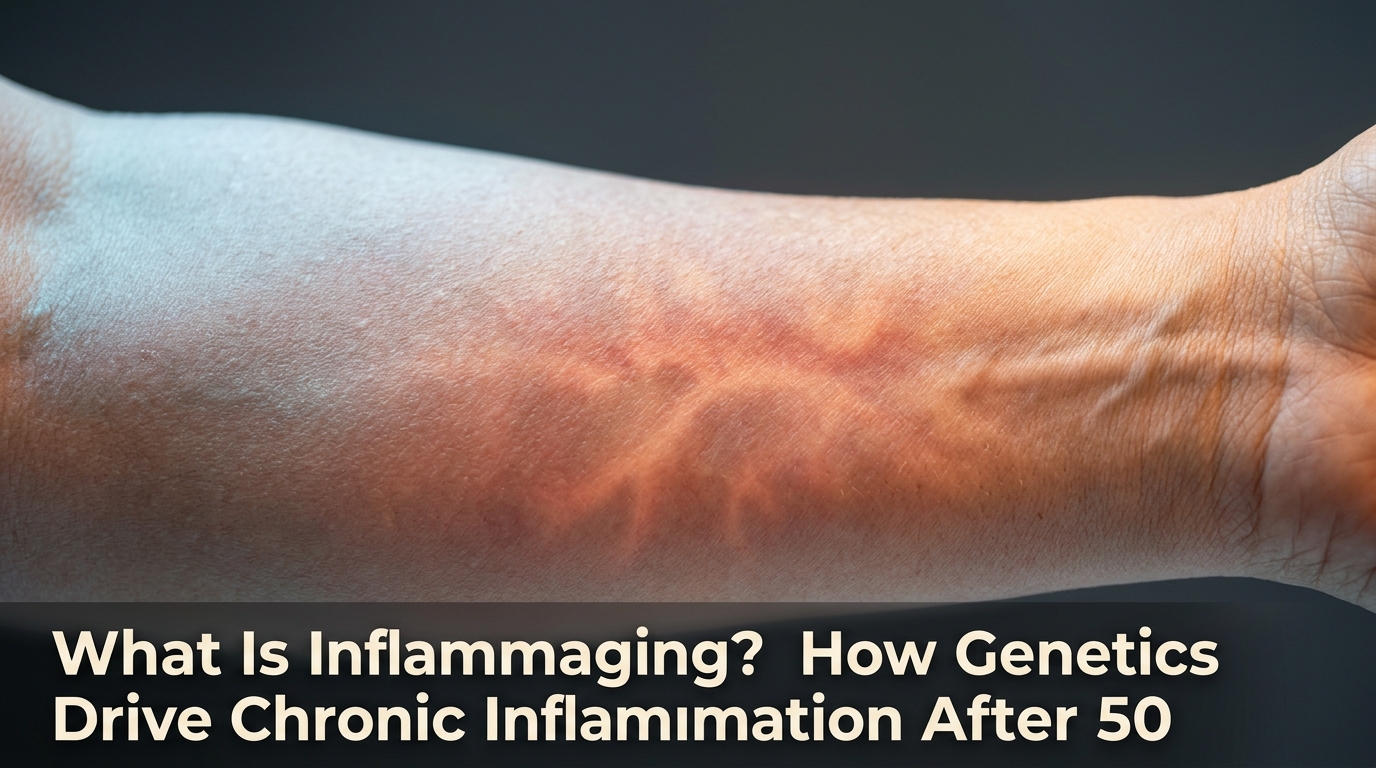
Learn what causes inflammaging in 2026 — from genetic markers to cellular senescence — and how chronic inflammation after 50 links to disease and aging.
Introduction
If you’ve spent any time reading recent aging research, you’ve probably run into the term “inflammaging” more than once. It’s not a buzzword dreamed up for a supplement label — it’s a real, actively studied mechanism that researchers now consider one of the central hallmarks of biological aging, showing up in cardiovascular disease, cognitive decline, frailty, and a long list of other age-related conditions. Unlike the inflammation you get from a sprained ankle or a cold, this version doesn’t announce itself. It builds slowly, quietly, and often without a single symptom you’d think to mention to your doctor.
That’s exactly why it matters more after 50. The processes driving inflammaging — cellular aging, genetic predisposition, accumulated lifestyle exposure — compound over decades, and the effects tend to become measurable right around the time other age-related changes start showing up too. Understanding what’s actually driving this process, including the genetic piece that explains why some people run a “hotter” inflammatory baseline than others, gives you a much clearer picture than vague advice to just “reduce inflammation,” which rarely explains what that means in practice.
This article walks through what inflammaging actually is, the cellular and genetic mechanisms behind it, the lifestyle factors that compound genetic risk, how it shows up in different body systems, how it’s measured, and what the research actually supports for managing it. Nothing here replaces a conversation with your doctor — think of it as the background that makes that conversation sharper.
Consider what this looks like in practice for two hypothetical people, both 55, both otherwise healthy by ordinary measures. One has a favorable genetic profile across the major inflammatory cytokine genes and a reasonably active, whole-food-centered lifestyle; a routine CRP test comes back low. The other carries higher-risk variants in IL-6 and TNF-alpha-related genes and leads a similar-looking lifestyle on paper — moderately active, generally healthy diet — yet their CRP comes back persistently elevated. Nothing about their daily habits looks obviously different to an outside observer, but their underlying inflammatory trajectories are meaningfully different, and only bloodwork reveals it. That’s the practical reason this article exists: to explain a process that’s largely invisible until you know specifically what to look for and why it varies so much between people who otherwise seem to be doing everything right.
What Is Inflammaging? A Plain-Language Definition
The term “inflammaging” was coined by immunologist Claudio Franceschi and colleagues to describe a specific kind of inflammation: chronic, low-grade, and “sterile,” meaning it isn’t triggered by an active infection or injury the way normal inflammation is. Instead, it’s a persistent, low-level activation of your immune system that builds gradually as part of the aging process itself, without a clear external trigger driving it.
This distinction from acute inflammation matters. Acute inflammation is protective — it’s your body’s rapid response to a cut, an infection, or an injury, and it resolves once the threat is cleared. Inflammaging doesn’t resolve the same way. <cite index=”35-1″>It reflects a dysregulated physiological state associated with elevated damage-associated molecular patterns, pro-inflammatory cytokines, altered immune cell composition, metabolic imbalance, and the accumulation of senescent cells exhibiting a senescence-associated secretory phenotype</cite>. In other words, several separate biological processes are all pushing in the same direction — toward a persistent, low-grade inflammatory state — rather than any single cause being fully responsible.
Since Franceschi’s original framing, the concept has grown considerably in the research world, moving from a theoretical idea into an active area of geroscience with its own biomarkers, measurement tools, and proposed interventions. It’s now understood as mechanistically connected to, but distinct from, immunosenescence (the general decline in immune function with age) — the two processes interact and reinforce each other, but they aren’t the same thing.
It’s worth sitting with why this concept has gained so much traction in aging research specifically. For decades, many age-related diseases — heart disease, type 2 diabetes, Alzheimer’s, certain cancers — were studied largely as separate conditions with their own distinct causes. Inflammaging offered researchers a unifying thread: a shared, underlying inflammatory process that seems to contribute meaningfully to several of these conditions at once, rather than each disease arising from entirely independent pathways. That’s part of why you’ll increasingly see inflammaging referenced not as a single disease itself, but as an upstream contributor that raises the risk and accelerates the progression of a whole range of downstream conditions. It’s less like a single diagnosis and more like a slowly rising tide that makes many other problems more likely to occur.
The Cellular Causes of Inflammaging
At the cellular level, several interconnected processes drive inflammaging, and it helps to understand them individually before seeing how they reinforce one another.
Cellular senescence is one of the most-discussed mechanisms. As cells age or accumulate damage, some enter a state called senescence, where they stop dividing but don’t die off the way damaged cells normally would. These “zombie cells” don’t just sit passively — they secrete a cocktail of inflammatory chemicals known as the senescence-associated secretory phenotype, or SASP, which spreads low-grade inflammatory signaling to surrounding tissue. <cite index=”34-1″>Cellular senescence plays a pivotal role in the development of inflammaging by contributing to the accumulation of senescent cells and pro-inflammatory SASP secretion</cite>. Macrophages, a type of immune cell, are particularly relevant here: <cite index=”31-1″>macrophage senescence can escalate to organ-level malfunction, making the body more prone to age-related diseases</cite>.
Mitochondrial dysfunction and oxidative stress form a second major pathway. Mitochondria, the energy-producing structures in your cells, become less efficient with age, generating more reactive oxygen species (a form of cellular damage) as a byproduct. <cite index=”32-1″>Inflammaging is driven by a variety of molecular age-related mechanisms, including impaired mitochondrial function, oxidative stress, DNA damage, inflammasome activation, and telomere shortening</cite>. When mitophagy — the process your cells use to clear out damaged mitochondria — becomes less efficient with age, damaged mitochondria accumulate and contribute even more oxidative stress and inflammatory signaling.
DNA damage and impaired autophagy round out the picture. Autophagy is your cells’ general cleanup and recycling process, clearing out damaged proteins and organelles; when it slows down with age, cellular debris accumulates and triggers inflammatory responses. <cite index=”31-1″>Autophagy defects, oxidative stress, and DNA damage generally contribute to inflammaging, largely through vicious cycles disrupting cellular homeostasis</cite>.
At the molecular signaling level, one pathway shows up repeatedly across nearly all of this research: NF-κB. <cite index=”32-1″>NF-κB is a central mediator of pro-inflammatory gene induction, and its upregulation has been documented in aging-related inflammatory disorders</cite>, often working alongside the NLRP3 inflammasome, a protein complex that activates inflammatory signaling in response to cellular stress and damage.
These cellular processes don’t operate as isolated, parallel tracks — they feed into each other in ways that make the overall system harder to reverse once it gets going. <cite index=”31-1″>Autophagy defects, oxidative stress, senescence-associated secretory phenotypes, and DNA damage are largely regulated by a two-level vicious cycle disrupting cellular homeostasis: one involving inflammaging and the cellular senescence cascade, and another involving autophagy defects, oxidative stress, and the SASP cascade</cite>. In plain terms, senescent cells release inflammatory signals that stress nearby healthy cells, pushing some of those cells toward senescence as well, which in turn produces more inflammatory signaling — a feedback loop that tends to accelerate rather than plateau over time without some kind of intervention. This is part of why researchers increasingly frame inflammaging as a systemic, self-reinforcing process rather than a simple linear accumulation of isolated damage.
The Genetic Side of Inflammaging
Here’s where individual variation becomes important: not everyone’s inflammatory system ages at the same rate, and genetics is a documented part of why. <cite index=”30-1″>Genome-wide association studies have identified variants in genes encoding pro-inflammatory cytokines, most notably IL-6, IL-1β, TNF, and NF-κB pathway components, that associate with longevity and disease susceptibility</cite>. In practical terms, this means two people can face similar lifestyle exposures — diet, stress, sleep — and still land at meaningfully different inflammatory baselines, because their underlying genetic wiring for cytokine production runs differently.
<cite index=”30-1″>Franceschi and colleagues originally framed inflammaging as a progressive reshaping of inflammatory mediator expression driven in part by chronic antigenic load and genetic predisposition</cite>. That framing has held up well as research has expanded: genetic polymorphisms don’t just affect immune signaling proteins directly, they also affect metabolic enzymes that intersect with inflammatory pathways. <cite index=”29-1″>Genetic polymorphisms in glycolytic enzymes like HK2 and PFKP contribute to interindividual variability in trained immunity</cite>, suggesting that metabolism and inflammation are more intertwined at the genetic level than a simple “inflammation genes” framing might suggest.
Genetics doesn’t work in isolation here, either — it interacts with epigenetics, meaning the way your genes are expressed can shift over your lifetime based on environmental exposures, independent of the underlying DNA sequence itself. <cite index=”30-1″>DNA methylation is the most thoroughly studied epigenetic layer in aging, and epigenetic aging clocks such as PhenoAge, GrimAge, and DunedinPoAm are widely used to estimate a person’s biological age from DNA methylation patterns</cite>. These clocks matter because they can reveal a gap between your chronological age (how many birthdays you’ve had) and your biological age (how “aged” your cells and tissues actually appear at a molecular level) — and inflammaging is one of the processes these clocks are, in part, capturing.
It’s worth being clear that genetics sets a tendency, not a fixed outcome. <cite index=”30-1″>Population and environmental modifiers, including genetics, diet, lifestyle, microbiome composition, and industrialization, all influence the inflammaging trajectory together</cite> — meaning your genetic predisposition interacts with everything covered in the next section, rather than determining your inflammatory fate on its own.
There’s also a growing area of research trying to combine genetic information into a single composite risk picture rather than looking at individual gene variants in isolation. Some researchers have proposed genetic inflammatory indices that combine multiple cytokine-related variants into one score meant to predict overall susceptibility to inflammaging, an approach that acknowledges what individual gene studies often miss: no single variant acts alone, and it’s the combined genetic profile across several inflammatory pathway genes that likely matters most for predicting who runs a hotter or cooler inflammatory baseline. This kind of composite approach is still early-stage research rather than a standard clinical test you’d get at a routine checkup, but it reflects where the field seems to be heading — away from single-gene explanations and toward integrated genetic risk profiles, similar to how cardiovascular risk calculators already combine multiple individual risk factors into one overall score.
Environmental and Lifestyle Triggers That Compound Genetic Risk
If genetics sets your baseline, lifestyle and environment are the levers that push you further along — or help hold the line. Diet is one of the more consistently studied factors. Diets heavy in refined carbohydrates, added sugar, and processed food are associated with higher circulating levels of inflammatory markers, while diets emphasizing vegetables, fiber, and healthy fats tend to move those markers in the opposite direction. The ratio of omega-6 to omega-3 fatty acids in a typical Western diet — often skewed heavily toward omega-6 from processed seed oils — has also been implicated as a contributing factor to systemic inflammatory tone over time.
The gut microbiome has emerged as a particularly important piece of this picture in recent years. <cite index=”30-1″>Researchers have connected gut microbiota to both metaflammation and inflammaging</cite>, a term describing the low-grade, diet-associated inflammation that arises partly from disruptions in the gut’s bacterial balance, known as dysbiosis. A gut microbiome that’s been shifted by a long-term low-fiber, high-processed-food diet appears to contribute to systemic inflammatory signaling in ways that researchers are still actively mapping, but the general direction — a healthier, more diverse gut microbiome associating with lower inflammatory markers — is fairly consistent across the current literature.
Beyond diet, <cite index=”34-1″>environmental and lifestyle factors such as exposure to pollutants, diet, and stress can further accelerate inflammaging</cite>, and the effects aren’t uniform across everyone — <cite index=”34-1″>men appear generally more susceptible to pollutant-induced inflammation while women are more affected by indoor pollutants and endocrine disruptors</cite>, illustrating just how many variables intersect here beyond a single “cause.” Chronic psychological stress, poor sleep quality, and sedentary behavior all show consistent associations with elevated inflammatory markers as well, and visceral fat — the metabolically active fat stored around abdominal organs — is itself considered an active contributor to systemic inflammation, not just a passive marker of poor health.
It’s worth understanding why visceral fat specifically gets singled out in this research, rather than body weight in general. Unlike subcutaneous fat sitting just under the skin, visceral fat is metabolically active tissue that produces its own inflammatory signaling molecules directly, functioning almost like an additional inflammatory organ rather than simple stored energy. This is part of why two people at a similar body weight can have meaningfully different inflammatory profiles depending on how their fat is distributed — someone carrying more weight around the midsection tends to run a higher inflammatory baseline than someone carrying a similar amount of weight elsewhere, independent of the number on a scale. It’s also one of the more directly modifiable factors on this entire list, since visceral fat responds relatively well to a combination of dietary changes and regular movement, even when total weight loss is modest.
How Inflammaging Shows Up in the Body
Because inflammaging is a systemic process, it doesn’t confine itself to one organ or system — it shows up differently depending on which tissues are most vulnerable to sustained low-grade inflammatory signaling.
The cardiovascular system is one of the most heavily studied targets. <cite index=”32-1″>Chronic low-grade systemic inflammation is a well-established hallmark of aging, and it’s driven by molecular mechanisms leading to cellular senescence, including impaired mitochondrial function, oxidative stress, DNA damage, and telomere shortening</cite>, all of which contribute to blood vessel stiffening and plaque buildup over time. <cite index=”33-1″>Among the causes of inflammaging, deterioration of the immune system, mitochondrial dysfunction, dysbiosis, accumulation of damage-associated molecular patterns, together with genetic or epigenetic factors, contribute to atherosclerosis and heart failure with preserved ejection fraction</cite>, two conditions that become increasingly common with age.
Cognitive health is another well-documented target. Chronic, low-level inflammatory signaling in the brain is increasingly implicated in the trajectory toward cognitive decline, and this is part of why anti-inflammatory dietary patterns show up so consistently in brain-health research, independent of any single “brain vitamin.” Skin aging and joint health are affected too — inflammaging contributes to the breakdown of collagen structures in skin and the degeneration of cartilage in joints, which is one reason both processes accelerate in ways that feel disproportionate to simple chronological aging.
Sex differences add another layer of complexity worth knowing about. <cite index=”34-1″>Gender and sex differences in inflammaging are shaped not only by hormones like estrogen but also by genetic and epigenetic factors, including X-linked immune gene mosaicism, microRNA expression, and telomerase activity</cite>. This helps explain why inflammaging-related conditions don’t always present identically between men and women, and why hormonal transitions like menopause are increasingly studied as a distinct inflection point in a woman’s inflammaging trajectory, separate from chronological age alone.
The skin deserves a slightly closer look, since it’s one of the few organs where inflammaging’s effects are literally visible rather than requiring bloodwork to detect. Chronic low-grade inflammation degrades the structural proteins collagen and elastin over time, contributing to the thinning, sagging, and slower wound healing commonly associated with aging skin. Because skin is also directly exposed to environmental stressors like UV radiation and pollution, it experiences a kind of double exposure — internal inflammaging processes compounding with external environmental damage — which is part of why dermatology researchers increasingly study skin aging as a visible proxy for understanding systemic inflammaging processes happening elsewhere in the body, out of view.
How Inflammaging Is Measured
Because inflammaging often produces no obvious symptoms in its earlier stages, bloodwork and emerging research tools are considerably more reliable than how you feel day to day. The most accessible and commonly ordered marker is C-reactive protein (CRP), a general inflammation indicator that rises in response to a wide range of inflammatory processes, including the low-grade kind associated with inflammaging. Elevated CRP alone doesn’t tell you the specific cause, but a persistently elevated result — checked more than once, since CRP can spike temporarily for unrelated reasons — is a reasonable signal worth discussing with a doctor.
More specific markers include IL-6 and TNF-alpha, the same cytokines implicated genetically in the research above, along with homocysteine, which connects to the methylation pathways covered in nutrigenomics research and offers an additional, related window into cardiovascular and inflammatory risk. These aren’t always part of a standard annual physical, so it’s worth explicitly asking your provider whether they’re appropriate to check given your personal and family health history.
It’s worth understanding roughly how these markers relate to one another, since they’re not interchangeable. CRP is a downstream marker — your liver produces it in response to signals like IL-6, so an elevated CRP result reflects upstream inflammatory activity rather than being the source of it directly. This is one reason CRP is useful as a general screening tool, since it integrates signal from multiple inflammatory pathways into a single number, while IL-6 and TNF-alpha testing give more specific information about which particular signaling pathway is elevated. In research settings, combinations of these markers are sometimes used to build a more complete inflammatory profile than any single test could provide alone, though in routine clinical practice, CRP remains the most commonly ordered starting point simply because it’s cheaper and more widely available.
<cite index=”30-1″>Epigenetic aging clocks such as PhenoAge, GrimAge, and DunedinPoAm are among the most widely used research biomarkers of biological aging</cite>, and they’re increasingly available through direct-to-consumer testing services, though it’s worth knowing these are still primarily research tools. They can offer an interesting window into biological versus chronological age, but the field hasn’t yet reached the point where a single epigenetic clock result should be treated as a definitive clinical verdict the way standard bloodwork markers are.
Can You Reduce Inflammaging? What the Research Supports
The encouraging part of this picture is that inflammaging, while driven partly by genetics, is not simply something that happens to you passively. <cite index=”30-1″>Emerging mechanisms of inflammaging have enabled the development of increasingly sophisticated geroscience-based interventions aimed at promoting healthy aging</cite>, and several of the more practical, accessible levers have solid supporting evidence.
Dietary pattern is one of the most consistently supported interventions. Mediterranean-style eating — rich in vegetables, fruit, legumes, fatty fish, olive oil, and nuts, with limited processed food and added sugar — is associated across large studies with lower levels of inflammatory markers like CRP and IL-6, likely working through several of the mechanisms above at once: better gut microbiome diversity, reduced oxidative stress, and less metabolic strain overall.
Movement and sleep both have documented anti-inflammatory associations independent of diet. Regular physical activity, even at moderate intensity, is linked to lower systemic inflammatory markers over time, and consistently poor sleep is associated with the opposite effect, elevating inflammatory cytokine production in ways that compound with existing genetic predisposition. Chronic psychological stress management — whatever form that takes for you, whether it’s structured practices like meditation or simply addressing major ongoing stressors — shows similar associations, since sustained stress hormone elevation interacts directly with inflammatory signaling pathways.
Where genetics adds nuance is in prioritization, not permission. If you know or suspect you carry higher-risk variants in inflammatory cytokine genes, or if bloodwork already shows elevated CRP or IL-6, these lifestyle interventions carry more weight for you specifically than they might for someone starting from a lower genetic baseline — not because the interventions themselves change, but because your margin for drifting in the wrong direction is smaller.
Beyond the broad lifestyle categories, a few more targeted interventions are worth knowing about, even though the evidence behind them is generally earlier-stage than the diet and movement research above. Time-restricted eating patterns, where food intake is confined to a shorter daily window without necessarily reducing total calories, have shown some promising early associations with reduced inflammatory markers in smaller trials, thought to work partly through effects on autophagy and mitochondrial function. Compounds like curcumin, quercetin, and omega-3 fatty acids, discussed at length elsewhere in nutrigenomics research, target several of the specific cellular mechanisms covered earlier in this article — SASP signaling, oxidative stress, and NF-κB activation among them — though as with most supplement research, effect sizes in human trials tend to be more modest than laboratory studies would suggest, and quality, dosing, and individual genetic response all affect how much benefit any one person actually experiences.
When to Talk to a Doctor About Chronic Inflammation
Because inflammaging is largely silent in its early stages, it’s worth being proactive about bringing it up rather than waiting for an obvious symptom. Persistent, unexplained fatigue, new or worsening joint pain without an acute injury, a strong family history of cardiovascular disease or autoimmune conditions, or known genetic risk factors are all reasonable prompts to ask specifically about inflammatory bloodwork during your next checkup, rather than assuming it’s automatically included.
If your provider does order inflammatory markers, ask for the actual numbers rather than just a pass/fail interpretation, and ask whether it’s worth rechecking them periodically, since a single data point matters less than a trend over time. This is also a reasonable area to bring up genetic testing results if you have them, since a provider familiar with the research can help you interpret what a given variant does and doesn’t imply about your personal risk.
Finally, keep expectations realistic about timelines. Inflammaging develops over decades, and the interventions that help manage it work on a similarly slow timescale — meaningful shifts in inflammatory markers typically take months of sustained dietary and lifestyle change to show up on bloodwork, not days or weeks. That’s not a discouraging fact, just an accurate one, and it’s part of why consistency tends to matter more than intensity when it comes to managing this particular process.
It’s also worth thinking about which specialists might be relevant beyond your primary care provider, depending on what your bloodwork and history suggest. A cardiologist may be appropriate if inflammatory markers accompany other cardiovascular risk factors like elevated cholesterol or blood pressure. A rheumatologist becomes relevant if joint pain and inflammatory markers together raise questions about an autoimmune process rather than general inflammaging. And a registered dietitian familiar with anti-inflammatory eating patterns can help translate general dietary advice into something specific and sustainable for your actual life, rather than a generic list of foods to add or avoid. None of these referrals require a dramatic health event to justify — bringing up a persistently elevated inflammatory marker at a routine visit is a completely reasonable reason to ask whether any of these specialists would add value to your care.
Conclusion
Inflammaging is a genuinely well-documented mechanism of biological aging, not a marketing term, and it’s driven by a real interplay of cellular senescence, mitochondrial dysfunction, genetic predisposition in inflammatory signaling genes, and lifestyle factors like diet, sleep, stress, and gut health. Understanding this mechanism gives you a much more concrete target than vague advice to “fight inflammation” — it points toward specific, measurable markers you can track and specific, well-supported interventions that actually move those markers over time.
If you’re over 50 and haven’t had a conversation with your doctor about inflammatory bloodwork, family history, or your general cardiovascular and metabolic risk picture, this is a reasonable moment to bring it up. Genetics may set part of your baseline, but the diet, movement, sleep, and stress-management choices layered on top of that baseline are where you actually have influence — and the research increasingly supports that this influence is real, even if it plays out slowly.
Have you made a lifestyle change that showed up in your own inflammatory bloodwork, or found a resource that helped you understand your own genetic risk factors? Share your experience in the comments — it’s often more useful to other readers navigating this after 50 than another list of recommendations alone.