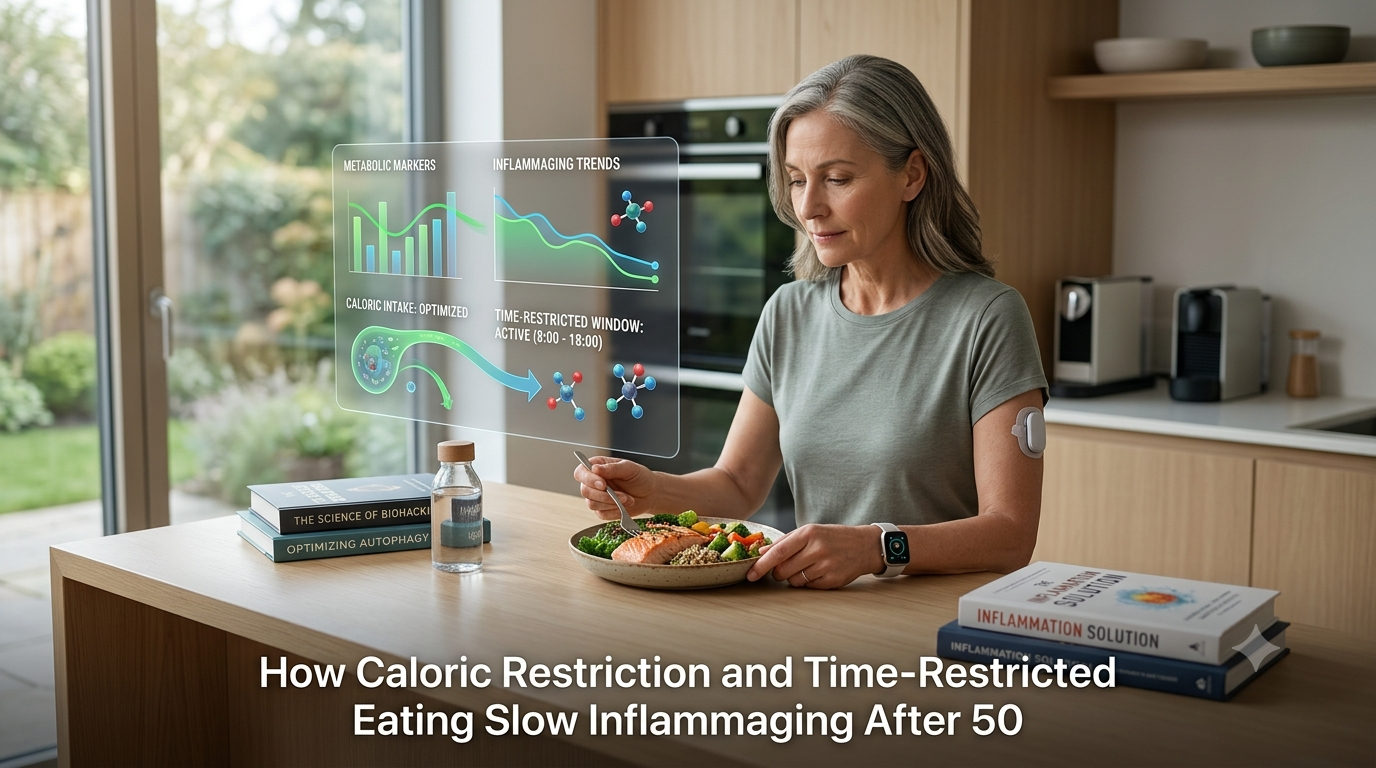
Caloric restriction and time-restricted eating are two of the most powerful evidence-backed tools for slowing inflammaging after 50. Discover the science, the protocols, and exactly how to implement them for lasting anti-inflammatory results.
Introduction
Here’s something the nutrition research community has known for decades but that rarely makes it into mainstream health conversations. Restricting caloric intake — without malnutrition — is one of the most reproducible longevity and anti-inflammation interventions ever identified across species. From yeast to worms to mice to primates, reducing caloric intake consistently extends lifespan and healthspan while dramatically reducing markers of chronic inflammation. And in humans, the evidence is increasingly compelling that both caloric restriction and its more accessible cousin — time-restricted eating — produce meaningful, measurable reductions in the inflammatory markers that drive every major age-related disease after 50.
What’s particularly interesting is that caloric restriction and time-restricted eating work through overlapping but distinct mechanisms — both activating powerful anti-inflammaging biological pathways, but through different entry points that make them complementary rather than redundant. Caloric restriction works primarily by reducing the absolute metabolic load on cells and the inflammatory byproducts that accompany excessive energy processing. Time-restricted eating works additionally through circadian biology alignment — synchronizing your metabolic activity with your body’s natural daily rhythms in ways that reduce the inflammatory consequences of metabolic-circadian mismatch.
Neither of these interventions requires exotic supplements or expensive equipment. They require understanding, planning, and consistency — which is why I want to spend time in this article making both the science and the practical implementation as clear as possible. After 50, when inflammaging is accelerating and the metabolic changes that come with hormonal shifts, muscle loss, and mitochondrial decline are making inflammation harder to control, the timing and quantity of what you eat become genuinely critical variables — not afterthoughts.
This article builds on everything we’ve established across this series — the mitochondrial biology, the gut health foundations, the Zone 2 exercise protocol, the supplement stack, and the senolytic interventions — and adds the temporal and caloric dimension that ties them all together into a coherent, comprehensive anti-inflammaging lifestyle. If you’re ready to take your protocol to the next level, The Prime Reset offers a structured, step-by-step program built specifically for adults over 50 who are serious about reversing inflammaging through evidence-based lifestyle intervention. Let’s get into the science.
What Caloric Restriction Actually Does to Inflammation Biology
Caloric restriction — defined in research as a sustained reduction in caloric intake of 15-40% below ad libitum (unrestricted) intake, without malnutrition — has a longer and more robust scientific evidence base for anti-inflammatory and anti-aging effects than almost any other nutritional intervention. Understanding its mechanisms helps clarify why it works and, importantly, why those mechanisms are relevant even at the more modest restriction levels achievable in real-world application.
The primary cellular sensor of caloric restriction is AMPK — adenosine monophosphate-activated protein kinase — the metabolic master switch we’ve discussed in multiple articles throughout this series. When caloric intake drops, the ratio of AMP to ATP inside cells rises, signaling an energy-deficient state that activates AMPK. Activated AMPK produces a cascade of downstream anti-inflammatory effects: it directly phosphorylates and inhibits NF-κB — reducing inflammatory gene expression across dozens of pro-inflammatory cytokines simultaneously. It activates PGC-1α, driving mitochondrial biogenesis and improving the mitochondrial function that, when compromised, is a primary source of the ROS-driven inflammatory signaling we covered in our mitochondria article. And it activates ULK1, the initiating kinase of autophagy — the cellular cleanup process that removes the damaged proteins, lipids, and organelles that act as endogenous inflammatory triggers.
Autophagy induction is arguably the most important anti-inflammatory mechanism of caloric restriction and the one most directly relevant to inflammaging reversal. Autophagy — literally “self-eating” — is the cellular process by which damaged or dysfunctional cellular components are tagged, enclosed in autophagosomes, and delivered to lysosomes for degradation and recycling. The cellular debris that autophagy clears — damaged mitochondria (cleared through mitophagy), aggregated and misfolded proteins, damaged lipid droplets, and even some senescent cells — are precisely the endogenous danger signals that activate NLRP3 inflammasome activity and drive the sterile inflammatory signaling that characterizes inflammaging. Caloric restriction, by robustly activating autophagy through AMPK and mTOR inhibition, directly addresses the accumulation of pro-inflammatory cellular damage that drives the aging inflammation cycle.
Sirtuin activation through caloric restriction provides another powerful anti-inflammatory mechanism through a completely different pathway. Caloric restriction raises intracellular NAD+ levels — because reduced glucose metabolism shifts the NAD+/NADH ratio toward NAD+ — and elevated NAD+ activates sirtuins, particularly SIRT1 and SIRT3. SIRT1 directly deacetylates and inactivates the p65 subunit of NF-κB, reducing inflammatory gene transcription. SIRT3 improves mitochondrial function and reduces ROS production. And SIRT6 regulates genomic stability and epigenetic aging — contributing to the biological age reversal effects of caloric restriction documented in our previous article.
The most compelling human evidence comes from the CALERIE trial — the Comprehensive Assessment of Long-term Effects of Reducing Intake of Energy — a large, multi-site randomized controlled trial that asked healthy non-obese adults to restrict caloric intake by 25% over two years. Participants achieved an average 12% caloric restriction and showed significant reductions in CRP, TNF-α, and multiple other inflammatory markers compared to controls. They also showed improvements in insulin sensitivity, reductions in visceral fat, and measurable improvements in cardiovascular risk markers — all consistent with the mechanistic predictions of the AMPK-autophagy-sirtuin anti-inflammatory cascade. This trial remains the most definitive human evidence that caloric restriction produces meaningful anti-inflammatory effects in non-obese adults — exactly the population most relevant to the over-50 inflammaging context.
Time-Restricted Eating — The Accessible Alternative to Caloric Restriction
Time-restricted eating — consuming all daily calories within a defined window of hours and fasting for the remainder — has emerged as the most practically accessible implementation of fasting-based anti-inflammatory intervention, and its evidence base has expanded rapidly over the past decade. While it shares significant mechanistic overlap with caloric restriction, TRE adds important dimensions related to circadian biology that make it distinctly valuable beyond calorie management alone.
The shared mechanisms between TRE and caloric restriction — AMPK activation, autophagy induction, sirtuin stimulation, mTOR inhibition — are activated during the fasting window of TRE even when total caloric intake isn’t deliberately restricted. The key insight is that these cellular stress-response pathways are activated not just by reduced calories but by the metabolic state of low insulin, depleted glycogen, and reduced glucose availability that develops during an extended fasting period. A 16-hour overnight and morning fast — the most widely studied TRE protocol — creates this metabolic state reliably every day, regardless of total caloric intake during the eating window.
The circadian dimension of TRE is what makes it genuinely distinct from simple caloric restriction, and it’s an aspect of the research that I find particularly compelling. Human physiology operates on a 24-hour circadian rhythm that regulates virtually every metabolic, hormonal, and immune process — including inflammatory signaling. Core body temperature peaks in the afternoon and declines overnight. Cortisol peaks in the morning and falls through the day. Insulin sensitivity is highest in the morning and significantly lower by evening. And the gut microbiome — which is one of the primary determinants of inflammatory status as established across multiple articles in this series — has its own circadian rhythm of activity and rest that is synchronized with the light-dark cycle and feeding-fasting cycle.
When eating occurs outside the body’s metabolically optimal window — late at night, inconsistently timed, or spread across 14-16 waking hours as in typical modern eating patterns — these circadian metabolic rhythms are disrupted, producing what researchers call circadian metabolic inflammation. Late-night eating impairs glucose metabolism through evening insulin resistance, generates post-meal glucose spikes that produce oxidative stress and inflammatory signaling, disrupts the gut microbiome’s circadian recovery patterns, and impairs the overnight inflammatory resolution processes that require a fasted metabolic state. TRE — particularly when the eating window is aligned with daytime and early evening rather than extending into late night — directly corrects this circadian metabolic inflammation by restoring the feeding-fasting rhythm that human metabolic biology is designed to operate within.
Key clinical trials have documented TRE’s anti-inflammatory effects in adults specifically relevant to the over-50 context. A 2020 study published in Cell Metabolism examined the effects of 16:8 TRE in men with metabolic syndrome — finding significant reductions in CRP, IL-6, and TNF-α alongside improvements in blood pressure, fasting glucose, and triglycerides over 12 weeks. A trial from the University of Alabama found that early time-restricted eating — eating within a 6-hour window ending by 3pm — produced dramatic improvements in insulin sensitivity and reduced oxidative stress markers even without caloric restriction. Research specifically examining TRE in older adults has documented improvements in the metabolic syndrome components that drive visceral fat-mediated inflammation, consistent with the mechanisms established above.
The migrating motor complex connection is one of TRE’s most underappreciated anti-inflammatory mechanisms. As discussed in our gut article, the MMC — the gut’s housekeeping contractile cycle — activates primarily during fasting periods and sweeps residual bacteria and food debris from the small intestine, preventing the bacterial overgrowth that drives small intestinal inflammation. A 16-hour fasting window provides robust daily MMC activation that a continuous eating pattern completely suppresses, directly reducing the gut bacterial stagnation and inflammatory fermentation byproducts that contribute to systemic inflammaging through the gut-inflammation axis.
The Specific Inflammatory Pathways These Interventions Target
Understanding the specific molecular pathways through which caloric restriction and TRE reduce inflammation illuminates why these interventions are so broadly effective — touching virtually every major inflammaging mechanism simultaneously — and why they’re synergistic rather than redundant with the supplement, exercise, and gut health interventions built across this series.
NF-κB suppression is the central inflammatory mechanism that both caloric restriction and TRE address through multiple converging pathways. AMPK activation directly phosphorylates IKKβ — the kinase that activates NF-κB — inhibiting it and reducing NF-κB nuclear translocation. SIRT1 activation directly deacetylates the p65 NF-κB subunit, preventing its transcriptional activity. Reduced insulin signaling decreases PI3K/AKT activity that normally contributes to NF-κB activation. And the ketones produced during extended fasting — particularly beta-hydroxybutyrate — have been shown to directly inhibit NLRP3 inflammasome activation, which sits upstream of some of the most important NF-κB-activating inflammatory signals. The convergent attack on NF-κB from multiple fasting-activated pathways is one of the primary reasons caloric restriction and TRE produce such broad anti-inflammatory effects across multiple tissue types simultaneously.
NLRP3 inflammasome inhibition deserves specific emphasis because it connects fasting and caloric restriction to the mitochondrial, senescent cell, and gut-derived inflammatory signals we’ve covered throughout this series. The NLRP3 inflammasome — the intracellular sensor that drives IL-1β and IL-18 production in response to endogenous danger signals — is activated by the very cellular damage products that accumulate with inflammaging: damaged mitochondrial fragments, uric acid crystals, cholesterol crystals, ATP released from damaged cells, and bacterial LPS from leaky gut. Autophagy, activated robustly by caloric restriction and fasting, directly clears many of these NLRP3 activating signals — damaged mitochondria through mitophagy, protein aggregates through selective autophagy — reducing the pool of endogenous danger signals that activate this primary inflammaging driver. Simultaneously, beta-hydroxybutyrate produced during ketogenic fasting directly inhibits NLRP3 through a specific binding interaction with the NACHT domain, providing an additional biochemical brake on this critical inflammatory sensor.
mTOR inhibition is another mechanistically significant anti-inflammatory effect of caloric restriction and TRE that connects directly to the biological aging interventions discussed throughout this series. mTOR — mechanistic target of rapamycin — is the cellular growth and anabolic signaling hub that, when chronically activated by excessive nutrient availability, promotes inflammatory gene expression, suppresses autophagy, and drives accelerated biological aging. The pharmacological mTOR inhibitor rapamycin is the most reliable lifespan-extending drug identified across multiple species, suggesting that chronic mTOR activation is genuinely one of the primary drivers of biological aging. Caloric restriction and TRE inhibit mTOR through AMPK-mediated signaling and reduced amino acid and glucose availability — producing many of the same anti-aging and anti-inflammatory effects as rapamycin without its immunosuppressive side effects.
Ketone production during extended fasting adds a unique anti-inflammatory dimension that pure caloric restriction without fasting doesn’t fully replicate. Beta-hydroxybutyrate and acetoacetate — the primary ketone bodies produced from fat during hepatic ketogenesis during fasting — are not just alternative fuel sources. They are signaling molecules with direct epigenetic, anti-inflammatory, and neuroprotective effects. Beta-hydroxybutyrate inhibits histone deacetylases — producing anti-inflammatory epigenetic changes — activates the HCAR2 receptor on immune cells to suppress macrophage inflammatory activation, and directly inhibits NLRP3 as described above. These ketone-mediated anti-inflammatory effects develop progressively through the fasting window and are most robust in the 14-16 hour range — which is precisely why the 16:8 TRE protocol produces more consistent anti-inflammatory benefits than shorter fasting windows that don’t reliably achieve ketogenic metabolic states.
Practical Protocols — Finding the Right Approach for Your Life After 50
The science is compelling. The practical implementation is where most people need the most help — because applying research protocols to real life after 50, with its specific metabolic, hormonal, and lifestyle considerations, requires more nuance than a simple “skip breakfast” instruction provides.
The 16:8 protocol — eating within an 8-hour window and fasting for 16 hours — is the most widely researched TRE protocol and the one with the strongest human evidence base for anti-inflammatory effects. For most people, a practical 16:8 implementation looks like eating between 10am and 6pm, or 11am and 7pm — allowing a substantial morning fast that extends through the early hours after waking before breaking the fast at late morning. This timing aligns reasonably well with circadian insulin sensitivity patterns while accommodating most social eating schedules. The key discipline is maintaining the eating window consistently — the same start and end times daily — to allow the circadian metabolic rhythms to synchronize with the feeding pattern.
The 14:10 protocol is the gentler entry point that I recommend as a starting place for people who are new to TRE, have significant metabolic dysfunction, are managing blood sugar issues, or find the 16:8 window too restrictive initially. Eating within a 10-hour window — for example between 8am and 6pm — still provides meaningful AMPK activation and autophagy induction during the 14-hour fasting window, delivers circadian alignment benefits, allows MMC activation during the overnight fast, and is substantially more sustainable for most people as a long-term daily practice. Research on 14:10 TRE specifically in older adults with metabolic syndrome has documented meaningful improvements in inflammatory markers, visceral fat, and glucose metabolism — confirming that significant caloric restriction isn’t required to access the anti-inflammatory benefits of fasting-based intervention.
The 5:2 approach — eating normally five days per week and consuming approximately 500-600 calories on two non-consecutive days — provides an alternative structure for people who find daily window-based restriction difficult but can manage periodic modified fast days. Research has shown that 5:2 produces comparable metabolic and inflammatory improvements to daily 16:8 TRE when matched for total weekly caloric reduction, suggesting that the total fasting time and metabolic state achieved matter more than the specific daily vs. weekly structure. The 5:2 approach can be particularly useful for people with variable social schedules who struggle to maintain a consistent daily eating window.
Several special considerations for adults over 50 deserve direct address because they’re frequently cited as barriers to TRE implementation. Muscle mass preservation is the most significant concern — because adequate dietary protein is critical for preventing the age-related muscle loss (sarcopenia) that compounds metabolic inflammation and reduces mitochondrial capacity. The solution is straightforward: prioritize protein intake within the eating window, targeting 1.2-1.6 grams per kilogram of body weight daily, and ensure at least one protein-rich meal within two hours of resistance training to maximize muscle protein synthesis during the eating window. Research examining TRE specifically in older adults with adequate protein intake shows no significant lean mass loss compared to unrestricted eating — it’s inadequate protein within the eating window, not the fasting window itself, that drives muscle loss risk.
Hormonal context matters differently for men and women after 50. Post-menopausal women may find that very aggressive caloric restriction or very long fasting windows (18+ hours) can stress the HPA axis and elevate cortisol in ways that paradoxically worsen visceral fat accumulation and inflammatory markers — the opposite of the intended effect. Starting with 14:10, ensuring adequate caloric intake within the eating window, and monitoring HRV and energy levels for signs of excessive physiological stress are sensible precautions for women navigating TRE post-menopause. Men over 50 generally tolerate 16:8 well from the outset, though monitoring for excessively low energy during morning fasting periods and adjusting timing as needed is always appropriate.
Combining Caloric Restriction and TRE With the Anti-Inflammaging Protocol
The true power of caloric restriction and TRE in the anti-inflammaging context comes from their integration with the comprehensive protocol we’ve built across this series — because these interventions don’t just work independently, they amplify and are amplified by virtually every other anti-inflammaging strategy we’ve covered.
The Zone 2 cardio and TRE combination is the most synergistic exercise-nutrition pairing in the entire anti-inflammaging toolkit. Performing Zone 2 sessions in the fasted state — typically in the morning before breaking the fast — combines AMPK activation from the overnight fast with AMPK activation from sustained aerobic exercise, producing additive mitochondrial biogenesis stimulation through dual PGC-1α activation that exceeds what either intervention alone achieves. The fat oxidation capacity benefits of Zone 2 are enhanced in the fasted state because glycogen depletion from the overnight fast forces greater reliance on fat oxidation during the Zone 2 session — accelerating the metabolic adaptation that makes Zone 2 increasingly effective for visceral fat reduction and inflammatory marker improvement over time. For practical implementation, a 45-minute Zone 2 session performed during the last two to three hours of the fasting window, immediately before breaking the fast, captures this synergy optimally.
Probiotic colonization and gut microbiome health are enhanced by consistent TRE through the MMC activation mechanism described above. The overnight fasting window allows full MMC cycling that prevents small intestinal bacterial overgrowth, creates a more favorable large intestinal environment for the beneficial bacteria introduced through probiotic supplementation and fermented food consumption, and allows the gut epithelial repair processes that depend on a fasted metabolic state to occur without the constant interruption of feeding. People implementing TRE alongside the probiotic and fermented food protocols from our gut articles consistently report faster and more durable improvements in digestive symptoms and, ultimately, in the inflammatory marker reductions that reflect genuine gut-driven inflammaging reversal.
The senolytic and TRE interaction is mechanistically fascinating and practically important for timing senolytic pulses. Fasting and caloric restriction independently reduce senescent cell burden through autophagy-mediated clearance of some senescent cells and through the reduced pro-senescence signaling that comes with lower insulin, lower IGF-1, and improved mitochondrial function. Performing senolytic pulses — the high-dose fisetin and quercetin protocol described in our senolytics article — during a period of consistent TRE likely enhances senolytic effectiveness by creating a cellular environment in which senescent cell anti-apoptotic defenses are somewhat compromised by the autophagy and AMPK activation of the fasted state. Specifically, timing the monthly senolytic pulse days to coincide with consistent 16:8 TRE rather than unrestricted eating may improve senolytic compound delivery to target tissues and enhance the apoptotic vulnerability of senescent cells.
Stacking TRE with the anti-inflammatory dietary protocol from our earlier articles produces combined inflammatory marker reductions that consistently exceed those from either intervention alone. The Mediterranean-pattern, polyphenol-rich, high-fiber, fermented food-inclusive diet that we’ve identified throughout this series as the optimal anti-inflammatory nutritional framework is, when consumed within a well-timed eating window, dramatically more effective than either the dietary pattern or the eating window alone. The dietary polyphenols activate the same AMPK and Nrf2 pathways that fasting activates, the fiber feeds the gut microbiome that the fasting window helps maintain, and the reduction of processed food and added sugar removes the inflammatory dietary signals that would otherwise counteract the fasting-mediated anti-inflammatory adaptations.
Tracking progress from TRE implementation is straightforward with the biomarker framework established across this series. HRV typically improves within two to three weeks of consistent TRE implementation — particularly in people whose previous eating pattern involved late-night meals that were disrupting their circadian autonomic recovery patterns. Fasting insulin and HOMA-IR typically improve meaningfully within four to six weeks of consistent TRE. Waist circumference — the proxy for visceral fat reduction — shows measurable change within eight to twelve weeks. hsCRP changes more slowly, typically requiring twelve weeks of consistent TRE plus the broader anti-inflammaging protocol to show meaningful reductions, with the most significant CRP improvements occurring when TRE is combined with Zone 2 exercise and the anti-inflammatory diet rather than implemented in isolation.
Conclusion
Caloric restriction and time-restricted eating are not trendy biohacks with questionable evidence. They are two of the most rigorously studied, mechanistically well-understood, and practically accessible anti-inflammaging interventions available — with a depth of evidence spanning decades of research across multiple species and increasingly compelling human clinical trial data. The inflammatory pathways they target — NF-κB suppression through AMPK and sirtuin activation, NLRP3 inhibition through autophagy and ketone production, mTOR inhibition through nutrient sensing pathways, circadian metabolic alignment through consistent feeding timing — sit at the absolute core of the inflammaging biology we’ve mapped across this entire article series.
The practical message is simple and sustainable. You don’t need to aggressively restrict calories or fast for 24 hours to access meaningful anti-inflammaging benefits from these interventions. Starting with a consistent 14:10 eating window — same timing every day, quality food within the window, no eating after 7pm — is enough to begin activating the AMPK, autophagy, and circadian alignment mechanisms that reduce inflammatory markers, improve insulin sensitivity, support gut health, and contribute to the biological age reversal that’s the ultimate goal of this entire protocol.
Build from there. When 14:10 feels natural and your HRV and energy confirm your system is adapting well, extend to 16:8. Add fasted Zone 2 sessions. Time your senolytic pulses within your TRE practice. Align your anti-inflammatory food choices within the eating window. And track your progress with the inflammatory biomarkers and HRV monitoring that give you real feedback on whether the biology is responding to your efforts.
The consistency and integration of these interventions — not the perfection of any single one — is what drives genuine, durable inflammaging reversal. Every article in this series has built toward exactly this kind of comprehensive, mutually reinforcing protocol, and caloric restriction and TRE are the temporal framework that ties it all together. If you’re ready to implement this complete anti-inflammaging system with expert guidance and a structured step-by-step protocol built specifically for adults over 50, The Prime Reset is the program that brings everything in this series together into a coherent, actionable plan. Start where you are. Build consistently. Measure objectively. And share your TRE experiences in the comments below — what protocol you’re using, what’s working, and what’s surprised you most about the results.